Valorant Champions Shanghai group stage delivers a brutal CN wipeout as T1 and JDG trade blows
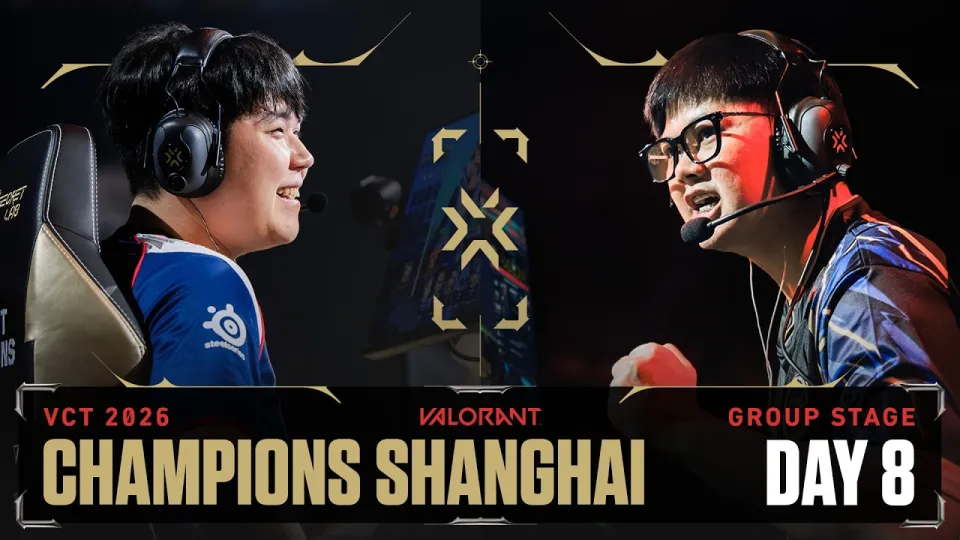
Video: VALORANT Champions Shanghai — Group Stage — Day 8
Want articles like this for your own video to promote it on YouTube and Google? Order them through the Telegram bot @sat_sit_bot. The bot writes and publishes the articles itself (with your YouTube video embedded) on popular topical websites (no ads). Free trial — 50 articles.
· based on the channel VALORANT Champions Tour
Key takeaways
- All four Chinese representatives at Valorant Champions Shanghai were eliminated before the playoff bracket.
- JDG held a 6-11 lead on map one against T1 and lost the series without converting it.
- Munchkin was fielded on a duelist for T1, a role swap that drew heavy criticism from viewers.
- A tech pause interrupted the broadcast, and a silenced Crown became the most talked-about moment of the day.
- Sixteen teams from Americas, CN, EMEA and Pacific entered the event running from September 24 to October 18.
Valorant Champions Shanghai closed its group stage with the harshest possible result for the host region: all four Chinese teams were eliminated before the playoff bracket, while T1 outlasted JDG in a series that swung on a single blown lead. The day confirmed what the wider VCT audience had suspected since Masters — home advantage in Shanghai meant nothing without execution against international opposition. You can follow every official bracket update and roster announcement through VALORANT Esports on X, where results, schedules and team news land first.
Why the CN wipeout defines the Valorant Champions Shanghai group stage
The group stage of Valorant Champions Shanghai ended with zero Chinese teams advancing, a result that reframes how the region's direct slots should be judged. Sixteen teams from Americas, CN, EMEA and Pacific entered the event, and the CN contingent exited as a complete block. The frustration in the community is not that Chinese teams lost, but that they lost in ways that suggested a preparation gap rather than a talent gap: dropped pistol rounds, hesitant retakes, and map picks that left star players on uncomfortable agents. The argument that CN teams simply were not ready to compete against the full international field is now the dominant reading of the group stage, and it is hard to counter with results.
JDG's 6-11 collapse on map one against T1
The single most damaging moment of the day was JDG's inability to close map one against T1 after building a 6-11 lead. That kind of advantage on the opening map is exactly the buffer a home crowd is supposed to protect, and JDG let it evaporate round by round instead of forcing T1 into desperate economy decisions. Viewers pointed out that a 2-0 sweep was genuinely on the table, which would have been an almost unheard result for a CN team on the global stage. Instead the series stretched, momentum flipped, and JDG's third map was widely described as their weakest showing of the event. The pattern is familiar from earlier international appearances: CN rosters can build leads against top-tier opponents but struggle to convert them once the opponent slows the pace and starts trading utility efficiently.
Munchkin on a duelist and other role experiments
T1's decision to put Munchkin on a duelist was the most questioned tactical choice of the broadcast. Munchkin built his reputation as a flexible initiator and controller player, so moving him onto an entry role changes both his utility responsibility and T1's default site-execute structure. The upside is unpredictability: opponents preparing for a standard T1 composition have to re-scout every default and every mid-round call. The downside is that duelist play demands a different kind of aggression and timing, and any hesitation shows up immediately in opening duels. Whether it was a one-off counter-pick or a permanent shift for the playoff run is the question T1's coaching staff will have to answer, because other teams now have film on it.
The Crown silence, tech pauses and the moments viewers keep replaying
Two broadcast details dominated the chat more than any individual round. The first was a silenced Crown, which viewers described as the most satisfying sound cue of the entire match — a small audio detail that landed as a psychological beat in a long series. The second was a tech pause that interrupted play and forced both teams to sit through a dead broadcast window, a recurring problem at large LAN events where server and stage infrastructure have to be reset mid-series. Neither changed the outcome, but both shaped how the day felt to watch. Technical stoppages also tend to cool hot teams: a roster riding momentum has to restart its rhythm after a pause, and that can quietly swing a map.
What the Shanghai library atmosphere says about the venue
Multiple viewers compared the arena to a library, a comment that recurs whenever a host region's teams are eliminated early. The acoustics of a large Shanghai venue with a reduced home crowd produce a flatter broadcast mix than a packed, partisan arena, and that changes how clutch rounds read on stream. A 1v3 retake feels different when the room is silent. For teams still alive in the bracket, the practical effect is neutral: pros play to the server, not the crowd. For the event itself, it is a warning about scheduling a world championship in a city whose local representatives can be wiped out before the knockout stage begins.
Typical questions from the group stage, answered
- Why did CN teams get direct slots if they underperformed? Slot allocation is a regional representation decision, not a form-based one, and the group stage is the mechanism that is supposed to separate contenders from representatives.
- Was JDG's loss a choke or a structural problem? Both readings exist. A 6-11 lead lost on map one points to mid-series adaptation failures, which is structural, but the third-map collapse points to composure.
- Does a role swap like Munchkin on duelist help or hurt? It helps as a surprise pick and hurts as a default, because duelist timing is a specialist skill that takes scrim blocks to internalize.
- Are tech pauses a competitive factor? They rarely decide maps alone, but they do reset momentum and force teams to re-warm, which matters in long series.
Reading the bracket after the group stage
The playoff picture after the group stage is a test of depth rather than star power. Teams that survived did so by winning the maps they were supposed to win and stealing one they were not, which is the standard formula for a deep Champions run. The eliminated CN rosters now face a longer offseason than any of them planned, and the regional debate about direct slots, practice infrastructure and international scrim access will follow them into it. For the remaining teams, the lesson is simple: leads at Champions are not leads until the map is closed.
Useful links
- VALORANT Esports on X
- VALORANT Esports on Facebook
- VALORANT Esports on Instagram
- VALORANT Esports on TikTok
- VALORANT on Twitch
Final takeaway
Valorant Champions Shanghai's group stage will be remembered less for who advanced and more for how completely the host region fell out of the tournament. JDG's blown 6-11 lead against T1 is the defining image, a lead that should have produced a historic 2-0 and instead produced another lesson in closing maps under pressure. T1's willingness to experiment with Munchkin on a duelist shows a team still searching for its best shape deep into the event. The silenced Crown, the tech pause and the library-quiet arena are the details that made the day feel strange rather than dominant. For the full broadcast and every remaining match, follow the VALORANT Champions Tour channel and check VALORANT Esports on X for official schedules and results.
Questions & answers
Did any Chinese team advance from the Valorant Champions Shanghai group stage?
No. All four CN representatives were eliminated before the playoff bracket, which is why the group stage became the main story of the event. The result sparked a wider debate about whether the region should keep direct slots or return to a merged APAC qualification path.
How did JDG lose to T1 after leading 6-11 on map one?
JDG failed to convert the lead round by round, letting T1 stabilize its economy and dictate the mid-round pace. Viewers noted a 2-0 sweep was realistic, and the eventual third map was described as JDG's weakest of the series. It read as a mid-series adaptation failure rather than a pure mechanical gap.
Why was Munchkin played on a duelist for T1?
Munchkin is known for flexible initiator and controller play, so putting him on a duelist changes T1's entry structure and forces opponents to re-scout their defaults. It works as a surprise pick, but duelist timing is a specialist skill and any hesitation shows up in opening duels. Whether it becomes a permanent role for the playoff run is a coaching decision.
What was the tech pause and the silenced Crown about?
The tech pause was an infrastructure stoppage that forced both teams to sit through a dead broadcast window mid-series. The silenced Crown was an audio cue that viewers found satisfying because it signaled a round swing. Neither decided the match, but both reset momentum and shaped how the day felt to watch.
Source: VALORANT Champions Shanghai — Group Stage — Day 8 · Markdown version